Photon Crystal Energy Named to the 2025 China Potential Unicorn List
Photon Crystal Energy has been named to Greatwall Strategy Consultants' 2025 China Potential Unicorn list. The company has completed engineering validation of its 100 MW pilot line, with mass-produced modules reaching 19% efficiency, more than 135 Wp in power, and yields above 90%, and is planning a 1 GW perovskite production line.
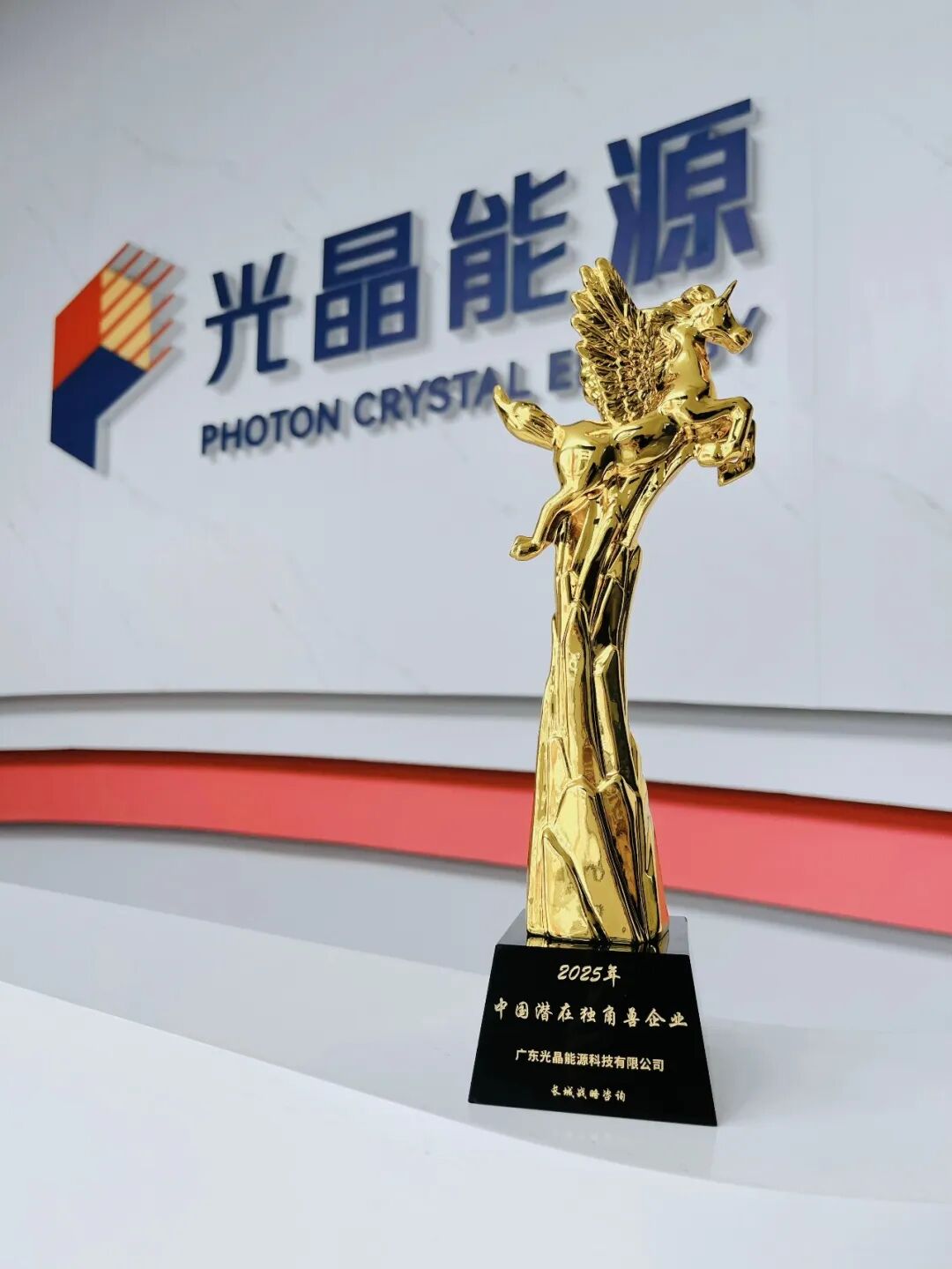
Photon Crystal Energy Technology Co., Ltd. has been named to the 2025 China Potential Unicorn list published by Greatwall Strategy Consultants.
Greatwall Strategy Consultants has long tracked the development of China's new-economy companies. Since 2016, it has conducted continuous research into unicorn companies nationwide and extended that research to the wider group of potential unicorns. Based on long-term research, its list examines companies' technological innovation, growth trajectory, and position in their industries. Photon Crystal Energy's inclusion recognizes the progress it has made in industrialization.
The Growth Requirements Behind a Potential Unicorn
Potential-unicorn status reflects a technology company's capacity for sustained growth. For a company committed to industrializing perovskite PV, it is not enough to discuss laboratory cell efficiency, the highest certified module efficiency, or even third-party stability certification. Photon Crystal Energy has already achieved third-party-certified small-cell efficiency of 28%, square-meter-scale pilot-line module efficiency of 20.8%, and dual international certification for module stability and safety under IEC 61215 and IEC 61730. However, for a company whose 100 MW pilot line has completed engineering validation, industrialization capability ultimately depends on product reliability and real delivery capacity.
A Development Path During Industry Adjustment
The PV industry is currently undergoing a period of deep adjustment. The crystalline-silicon module market faces simultaneous pressure from pricing, supply and demand, and technological iteration. The industrialization of perovskite modules must likewise address practical challenges including the coordination of efficiency and stability, scaled manufacturing, product-market fit, and cost performance. The more complex the industry environment becomes, the more important it is for companies to invest resources in their products, identify suitable market directions, open distinctive application scenarios, and turn technological advantages into sustained and verifiable product capabilities that can be proven in field applications and recognized by customers.
Photon Crystal Energy's Product Practice
Photon Crystal Energy's north-star metric is not another module-efficiency record. The company has consistently focused on coordinated efficiency and stability together with batch delivery. It continues to optimize everything from materials innovation and module structures to its distinctive fully printed technology. Drawing on two years of pilot-line operation, nearly one year of outdoor field validation, and feedback from customer sites, it continually recalibrates product iteration. Every performance improvement must pass repeated testing and engineering validation before entering the next stage of manufacturing and application. As long-life engineering products, PV modules must build customer confidence through real projects. Market adoption cannot happen overnight, while outdoor validation is measured in years and tests the patience of both the company and industry observers.
Outdoor Field-Validation Results
Photon Crystal Energy independently built an outdoor perovskite demonstration power station in Foshan, Guangdong, in August 2025. A year of accumulated data shows stable generation efficiency with no significant degradation. At equal rated power, the perovskite modules generated on average more than 15% more electricity than crystalline-silicon TOPCon modules. Thanks to perovskite's excellent low-light performance and very small temperature coefficient, the generation advantage exceeded 20% in rainy weather and high-temperature operating conditions. In southern China's rainy season, when crystalline-silicon output declines more sharply, the relative generation advantage of perovskite became even more pronounced. Over the full year, the perovskite modules generated 16% more electricity than crystalline-silicon TOPCon modules.
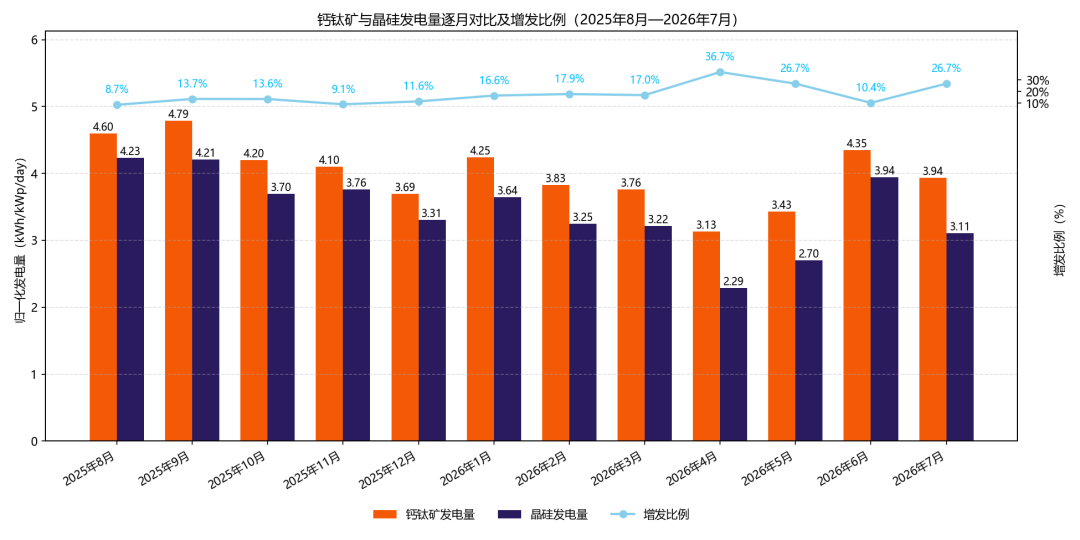
The same higher-generation trend at equal rated power has also been reflected in customer feedback from previously delivered distributed power stations and integrated solar-storage-charging carports. Customers have likewise recognized the products' stability. The company will continue tracking data from these projects and will disclose further field-validation results at appropriate times.
Progress in Mass-Produced Products
Bringing products to customers requires performance, reliability, delivery capacity, and cost to be evaluated together. Moving from a sample to large batches of modules involves comprehensive challenges in materials-system optimization, dimensional scale-up, process locking, production-line validation, and quality control. The move from standard modules to scenario-specific products places even greater demands on market insight, confidence in the technology, customization, and solution capabilities. Over the past two years, Photon Crystal Energy has systematically brought the variables of people, machines, materials, methods, and environment under control on its pilot line. Breakthroughs do occur, but most engineering challenges are solved one by one through the team's daily work on the production line. Across R&D, manufacturing, and delivery, these efforts have continually improved module efficiency, consistency, and stability while reducing cost, creating reliable and economical delivery capability.
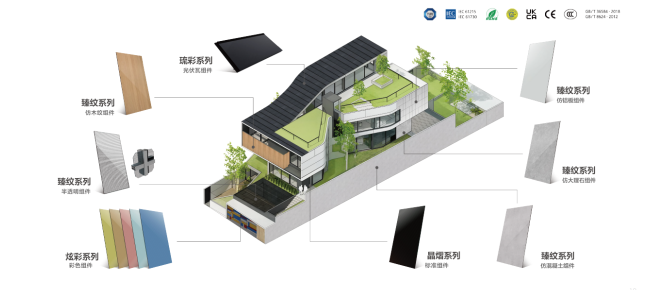
Photon Crystal Energy has now completed pilot-line engineering validation. Its mass-produced 1.2 m × 0.6 m standard modules reach 19% efficiency, exceed 135 Wp in power, and achieve yields above 90%, with reliable stability at a leading industry level. Based on these efficient and stable standard modules, the company has developed PV power-generating glass, PV wall products, solar tiles, and other BIPV products. These products have passed relevant national building-material standards and are beginning to be used in construction projects. Built on high-efficiency perovskite thin-film cell technology, they directly upgrade and replace earlier cadmium-telluride thin-film PV technology. While transparency, color, and material texture can be customized for architectural design requirements, electricity generation and cost performance improve by more than 20%.
Future Development Plans
Photon Crystal Energy will continue coordinating efficiency and stability, improving both performance and reliability, and raising mass-produced module efficiency above 20% so that electricity generation per unit area can match or exceed mainstream crystalline-silicon modules. Product reliability work will continue around a target operating life of more than 25 years through long-duration validation across multiple regions. The company will also keep reducing module costs by optimizing materials systems, manufacturing processes, and production workflows. Advancing these three priorities within one integrated product and manufacturing system will enable perovskite modules to create sustained economic value across more application scenarios and earn recognition from more customers.
Photon Crystal Energy thanks its customers, partners, investors, and employees for their trust and support. Every collaboration, validation project, and dataset is an irreplaceable part of the path toward perovskite industrialization. Inclusion on the list is an encouragement, and the company intends to turn that encouragement into motivation for continued progress. Photon Crystal Energy is planning an expanded 1 GW perovskite production line. With next-generation high-efficiency thin-film cell technology, it aims to open more applications in zero-carbon industrial parks and green urban buildings, bring PV more broadly into cities, and contribute to China's carbon-peaking goals during the 15th Five-Year Plan period.
Key Facts
- 2025 China Potential Unicorn
- 19% mass-production module efficiency
- More than 135 Wp
- Yield above 90%
- Planned 1 GW production line